
Many years ago, an agency I worked at had a lovely idea to launch their new identity. We were all asked to think of a phrase that inspired us every day, and share it with the management. Those phrases were then printed on little pin badges and assembled into a large canvas that hung at the entrance – the first thing people saw as soon as they walked through the front doors.
I worked in that office for four years, and those tiny metallic discs, dishing out little nuggets of wisdom, used to make me smile every time I saw them.
My phrase was Sight Through Insight. I thought it was rather smart. But the one that stayed with me the longest wasn’t mine. It was far simpler, and took years to fully understand.
See The Wood For The Trees.
It sounds obvious. But understanding it – really understanding it – required stepping back far enough to take in the whole room, instead of solely focusing on the canvas placed in its centre. And for me, that clarity arrived not in a studio or a client meeting, but in looking back at the years before this job – somewhere between endless international flights and the inside of a backpack.
For four years before Manchester, my wife and I travelled and worked continuously – England, Singapore, Hong Kong, Thailand, India, Indonesia – never staying long enough in one place to call it home. Which is how an unlikely third member joined our group. Not by choice, exactly. More by necessity, repetition, and the particular chaos of living out of luggage.
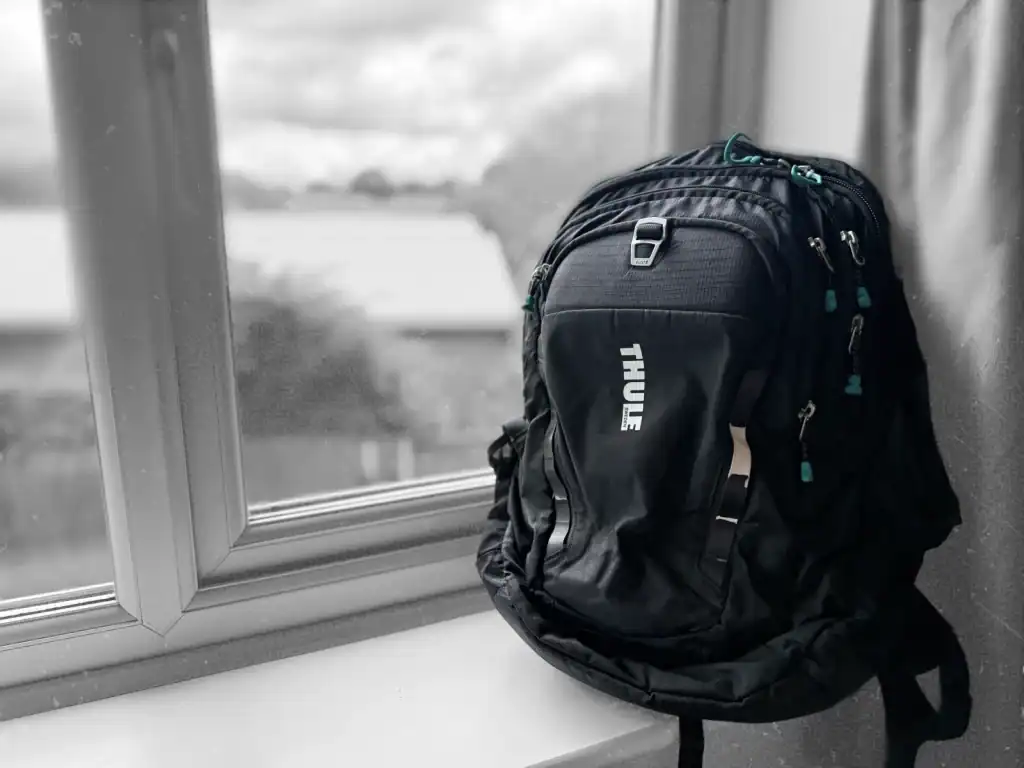
My Thule backpack.
I remember browsing sites looking for something that could tick a lot of boxes – strong build, good storage, trusted brand. Something that could take a beating, handle any weather, and still look acceptable in a client meeting. I was running a checklist without realising I was doing it.
The Thule checked every box. And over the next four years, it created some new ones.
It went from being a piece of luggage to becoming my mobile office – everything inside finding its place not by instruction, but by repetition and need. It started as an object mass-produced for everyone. It ended up as an irreplaceable part of my life – designed by me, for me.
And somewhere along the way, it did the unlikeliest thing. It taught me to see the wood for the trees.
Chapter 1: The Things That Shaped Themselves
The Thule and I self-organised over time. Although its structure suggested how it should be used, four years of airports, client meetings, and the shifting weather patterns of six countries decided otherwise.
The most effective designs aren’t just built. They are lived into.
The iPad pocket became the document sleeve. The water bottle pocket discovered a talent for tucking more sandwiches than should be legally permitted. Clasps and carabiners appeared on the outside, supporting a dangling array of travel pillows, flasks, and things that didn’t fit anywhere else. The compartments also developed a hierarchy based on urgency – passports and keys at the top, everything else ranked by how likely I was to need it in a hurry.
I didn’t know it at the time. I couldn’t see the wood for the trees. But an ordinary piece of luggage was quietly being subjected to well-documented design principles – proximity, frequency of use, muscle memory, context – each one emerging not from a predetermined set of tasks but from the particular friction of each day bringing with it a new challenge. Each one contributing to the organic evolution of an everyday product.
The backpack isn’t unique in this. Think of the IKEA workbench that looks completely different in every garage it lives in, shaped by the specific hands that use it, and the myriad of tasks it’s used for. The family kitchen, imperfectly perfect – organised around the people who cook in it – a flawless method emerging from within all the madness. The dog-eared cookbook where the most loved recipes fall open naturally, and the splashes, annotations and scribbles become a better navigation system than any index could be.
These aren’t UX analogies. They are lived experiments in human-centred design. They prove something we forget the moment we open a design tool – we have always built around our own behaviour. The system has always served the person, not the other way around.
Think of it as the design equivalent of time under tension. The longer you spend with something, the more it gives back.
The best of design remembers that. A lot of it has forgotten.
Chapter 2: The Patterns That Forgot
Nobody uploaded a UX playbook to our collective consciousness. Our ideas were always borrowed from a world we understood – a world that gently taught us through physical touch and patterns that shaped themselves.
Good design that we love interacting with traces its roots back to this very physical intuition.
Bad design traces back to shortcuts.
Take the infinite scroll. Someone decided that giving people a natural stopping point, something that would keep them from endlessly flicking their finger on a screen, was bad for engagement. So they removed it.
Compare that to a well-worn book. Imagine its weight in your hands. You know immediately how far through it you are, how much remains, and whether you have time for another chapter before you risk sleep deprivation. Every page turn is a conscious choice. The book respects your time, and your decision to progress because it has to. By design, it has an end.
Infinite scroll never ends. That’s not a feature. It’s a decision someone made about what your attention is worth, whilst giving you as little control as possible.
The physical object was honest about its own limits. The digital pattern was designed to obscure them. It removed those limits and called it progress.
The Wrap up
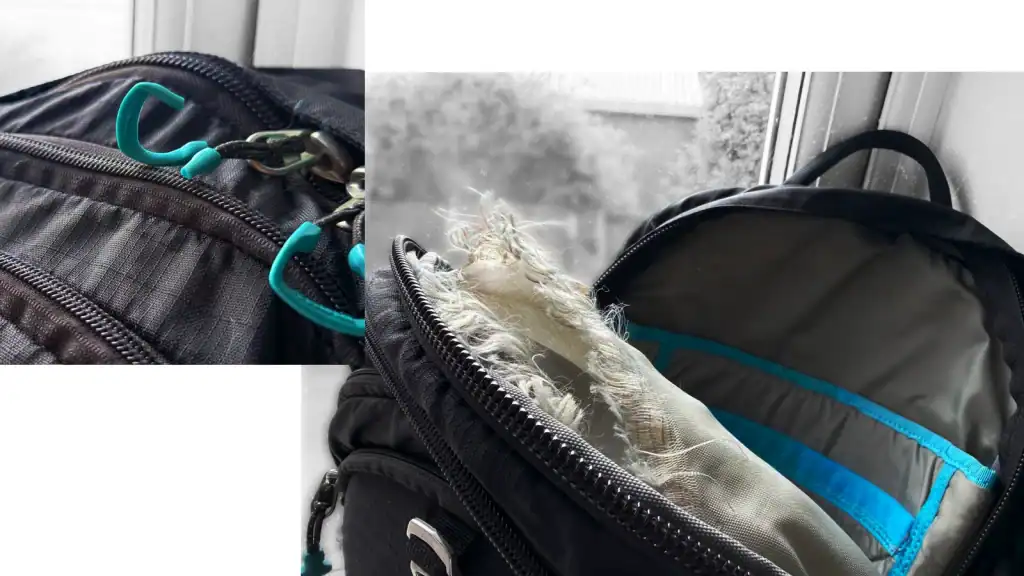
My Thule backpack now rests in a cupboard, shaped by years of use. One strap is torn. The laptop pocket has all but disintegrated. It served me well across four years, six countries, and more client meetings than I can count.
And yet it will never be thrown away to make space for something else.
It’s not because the bag was beautifully designed or held some flaunt-value for the brand-conscious. It was because it ended up being designed by me. It went from a piece of luggage to an irreplaceable part of my life – a reliable, familiar fixture from pitch rooms to photo albums – because it was a product that learnt from me and was shaped by me.
We just don’t see that enough when we transition to pixels.
I don’t think digital design got it wrong. It just chose to trade consideration for efficiency and forgot to look back. It forgot that the best systems don’t arrive fully formed – they earn their place through use, through friction, and the needs of the specific person living with them.
That’s the standard digital design should hold on to.