
There’s a school of thought that says it takes ten thousand hours to master a craft. That’s almost 10 years of religiously pursuing a single passion. Whilst I wouldn’t sell that as a science, the logic behind it is undeniable. Deliberate practice leads to deliberate expertise.
That is unless you’re a prodigy on your way to becoming the next Messi, Mozart or Magnus Carlsen. In which case, I look forward to seeing you from the stands.
For the rest of us, whilst the end goal is what sets us off, what really shapes us is the path we take that leads to it. The destination is just the natural conclusion of everything we experience, and everything we discover along the way.
Every article on this platform started somewhere else entirely. The published version, in front of your eyes right now, became the destination. But what made it possible lives in the drafts you’ll never see. It’s in the internal monologues, the wrong turns, and the ideas that got discarded along the way.
The words that were thrown away revealed what the article wasn’t about. And that became more useful than knowing what it was.
Nobody starts off with an entire finished product assembled and envisioned in their head. It only exists because of everything that preceded it. How many brushstrokes were painted over before the canvas revealed the true Mona Lisa? How many demos were scrapped before ‘Imagine’ sang through our speakers?
The end product carries the weight of everything that didn’t make it. The frustrations, the do-overs, the endless drafts – invisible scaffolding that allows your final creation to stand tall.
So what happens when we choose to jump straight to the destination, completely bypassing the journey?
Chapter 1: Three Points, One Place
Every challenge, large or trivial, starts with a question and ends at an answer. The line connecting the two is the solution. How long or short that line is depends on all the friction, the insights, and the failures experienced along the way.
I see this pattern constantly in my work. Three anchors of every workflow – the client, the designer, and the brief – interconnected and interdependent. The client chooses the destination. The designer plans the journey. The brief is where both come together to agree on the itinerary.
All three start in different places. And the work – the real work – is the process of moving them toward the same point.
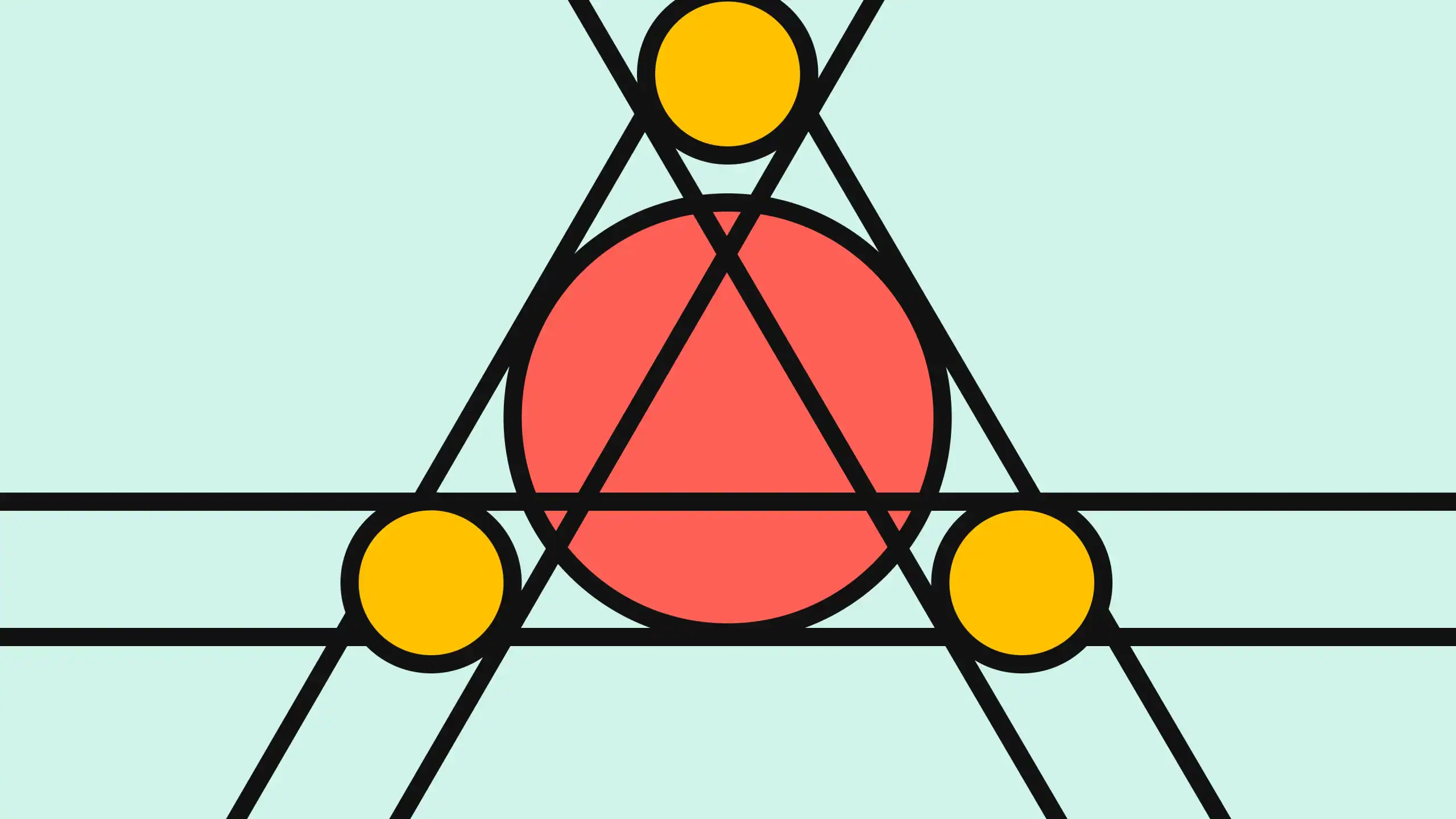
I call this the disappearing triangle.
The most important part of the triangle is the space in the middle, where everything actually happens. It’s the invisible scaffolding built from multiple failures, each one revealing new insights, and each one gradually closing the space between what the client intended and what the designer interpreted.
Until there is no triangle left.
That moment – when all three constants occupy the same place – is design success. Success through understanding that was methodically mined, not randomly discovered or agreed upon.
You can accelerate the process. You cannot skip it. The instinct to jump to the moment where the triangle disappears – without the friction that made it possible – is self-sabotage dressed as speedy success.
The most dangerous brief is the one that sounds right from the beginning. The riskiest product is the one that looks polished from the first draft. Because ‘good enough’ doesn’t get questioned. And a lot of times, ‘good enough’ is mostly enough.
Chapter 2: Someone Else’s Foundations
Last week I built a fully coded prototype using Lovable. From the first keystroke to a fully coded product, the entire process took a little over three hours. Something that would have taken weeks across design, code, user journeys, databases, forms, and fully interactive workflows – built before lunch.
To watch it come to life was fascinating. I saw my vision interpreted and built into something real and technically functional.
But it also felt incomplete. And maybe a little ungratifying.
Let me expand on that with an analogy.
Say you’re in the market for a house. You find one that clears most of your checklist – budget, location, space – and you work around the rest. You move in.
But it doesn’t quite feel like yours. So you change the wallpaper, move the furniture around, knock a few walls down. But you never commit to breaking the entire structure and rebuilding it. Because going that far feels needlessly laborious when something already exists that does the job.
And your reasoning seems justified as well. You accepted the fact that a house that wasn’t yours till a week ago came fully specced and ready to move in. Why fix something that doesn’t look broken? You accept its every quirk as a compromise you inherited, and every niggle as a further compromise you accepted. And the longer you live there, the more normal those compromises feel – until you stop noticing them entirely. ‘Good enough’.
Compare that to a house built with your bare hands over months, or years. Every decision is yours. Every compromise is conscious. Every mistake tells a tale and every imperfection is an anecdote. The final structure carries the evidence of your thinking at every point. It removes the scope of ‘what-ifs’ entirely. You even stop seeing it as just a house. It’s your story, told brick by brick.
The AI-generated solution carries none of that. It is technically a house, but it was handed to you, and it will never tell your full story.
Which explains what I felt when I saw my Lovable prototype, and it had nothing to do with nostalgia. I didn’t feel I deserved the product in its original iteration because the process felt too easy. I instinctively started chipping away at it – working through its cracks and compromises, rebuilding section after section. And none of this was because it was missing the polish. Lovable had changed the wallpapers of the house and they were brilliant. But it was missing the understanding that only forms when you build something from scratch.
When you’re working with a client, the stakes aren’t personal. They span businesses and demographics. The compromises you inherit become theirs as well. Every time the client’s needs evolve, or the problem shifts, or something breaks – it’s the person who built from scratch who knows exactly where to look. The person who inherited a working prototype and moved in doesn’t know where the walls are load-bearing.
Fully functional products developed using AI in three hours are useless if you don’t possess the craft to dismantle them, critique them, and rationalise them.
This is the toll of skipping the journey – you end up a guest in your own house.
The wrap-up
It took multiple drafts to get this article to a place where I was happy for it to be read. The first draft asked a different question. The second draft answered the wrong one. The third started to uncover what this was actually about.
The final version is better for all of that. Not despite it.
The destination was always the point. But the journey is how you earn the right to arrive there – and the understanding to know what to do when you do.
But as processes become automated, and journeys become shorter, we risk losing the failures that teach us where the walls are load-bearing, and the drafts that pave the way to the end product.
The fastest route to an answer is often the longest route to understanding it.
And in a world that’s changing faster than we can keep up with, ‘good enough’ just isn’t good enough.